Key facts
- Version 1 = 21, version 3 = 29, version 40 = 177 modules per side.
- Formula: side = 21 + 4 × (version − 1), border not counted.
- White border: four free modules around the symbol.
- Repair L/M/Q/H: about 7%, 15%, 25% and 30% of codewords.
Version, side and side with border
| Version | Modules per side | With border (modules) |
|---|---|---|
| 1 | 21 | 29 |
| 3 | 29 | 37 |
| 10 | 57 | 65 |
| 40 | 177 | 185 |
The example 37 × 0.254 mm = 9.398 mm is a geometric calculation, not a universal minimum.
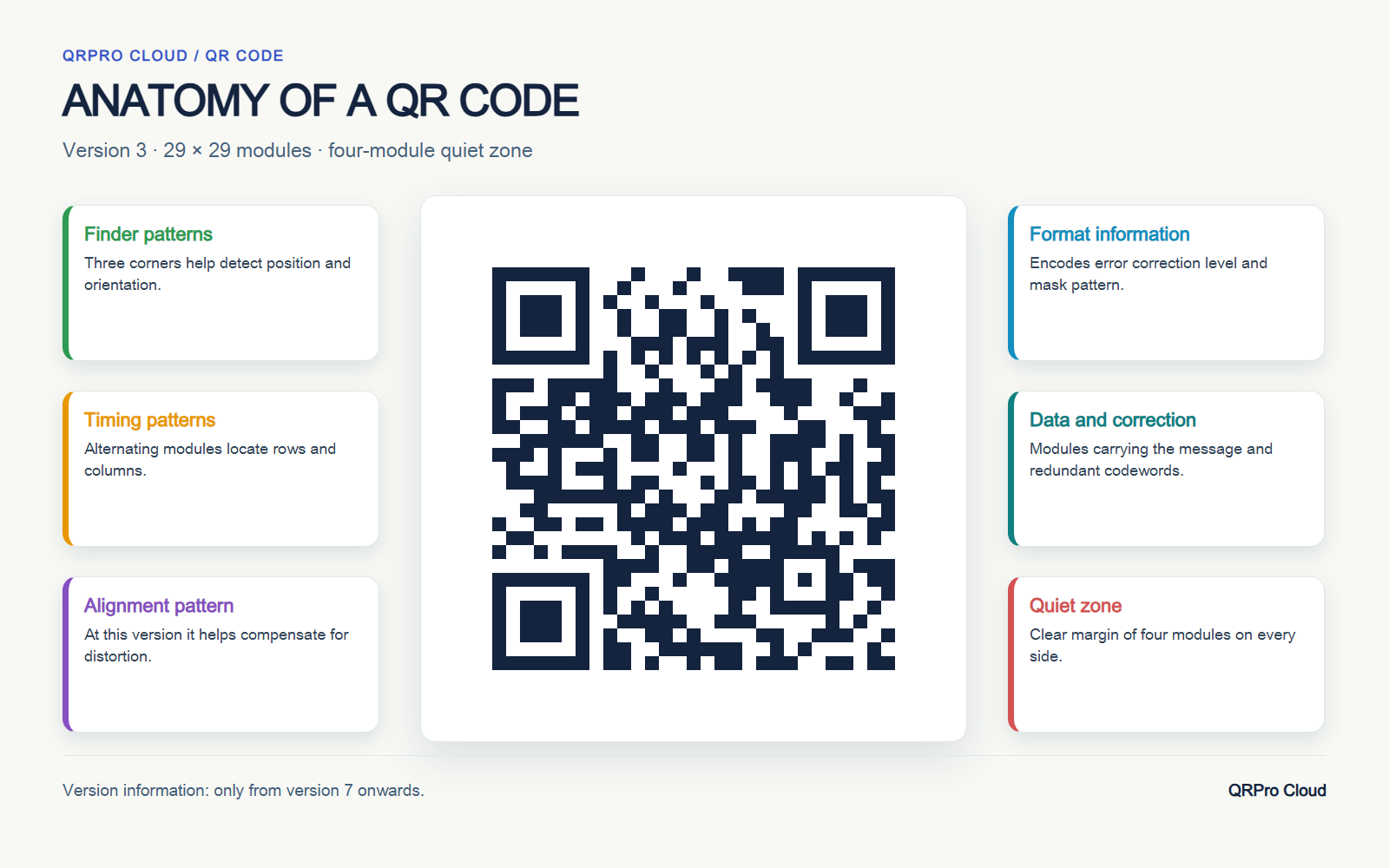
Which parts does a QR code have?
Think of a house plan. The three large corner markers tell the phone where the picture is and whether it is turned. A line of alternating squares marks rows and columns, like notebook lines. Another area holds the link, plus spare pieces that fill in damaged parts. Around everything is a clear white border of four small squares.
How does a QR code grow?
The smallest size has 21 small squares per side. Each next size adds four per side. The formula is side = 21 + 4 × (v − 1). For example, version 3 is 21 + 4 × 2 = 29 squares per side. There are 40 sizes, up to 177 squares per side. More text makes the picture grow.
How much damage can a QR code handle?
The code has spare pieces that fill in damaged parts. The four levels, L, M, Q, and H, can recover about 7%, 15%, 25%, or 30% of the data. This does not mean you can cover that part safely: damage location, print contrast, and scanning conditions matter. More spare pieces leave less room for your text. A print example: version 3 is 29 squares wide; with four clear squares on each side, the full area is 37 × 37. At 0.254 mm per square, that is 9.398 mm. It is a geometric example, not a universal minimum size. For the wider context, read The QR standard: why phones read the same code.
What questions do people ask about QR anatomy?
What is one QR module?
One module is one small black or white square. A QR code's size is counted in modules per side.
What do the three large corners do?
They help the camera find the code and tell it whether the code is turned or tilted.
How much damage can a QR code take?
It depends on the repair level and where the damage is. The four levels recover about 7% to 30%.
How many QR sizes are there?
There are 40 versions, from 21 to 177 modules per side; the symbol grows when you need more text.
What clear space should I leave?
Leave a four-module white border around the whole symbol and use high contrast.